Trading Account: Can I Open one at an International Online Brokerage?
What is a trading account?
Trading accounts at international brokerages
Cross-listing on stock exchanges.
Things to consider additionally
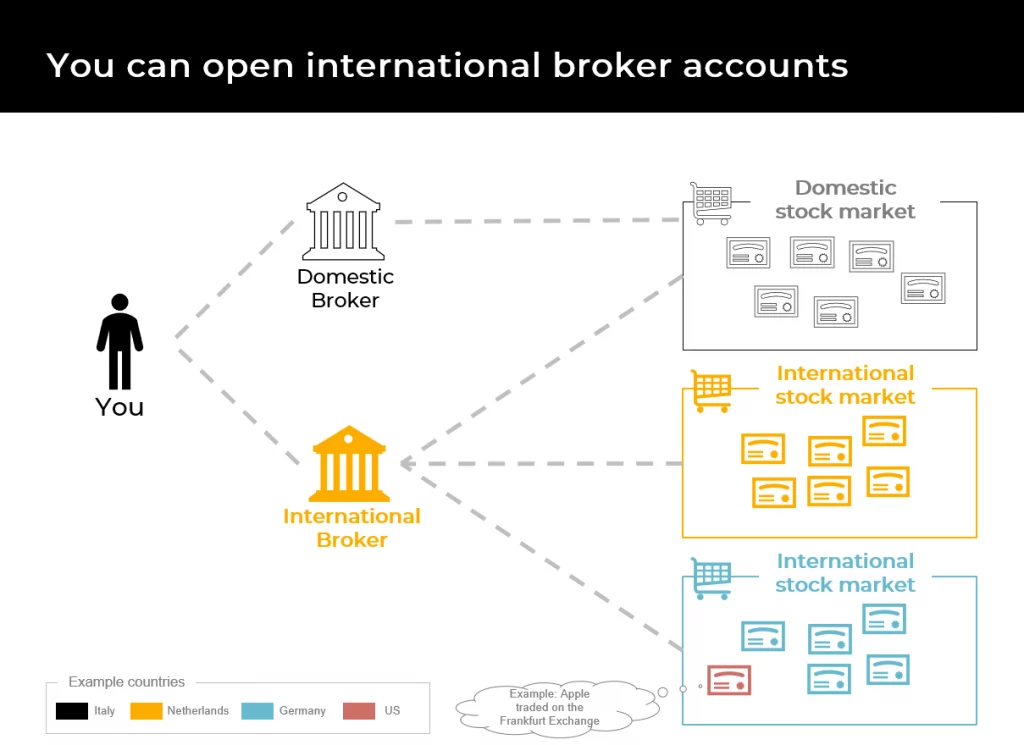
Can an Italian open a trading account at a Dutch broker and buy an American stock on a German stock exchange?
For example, an Italian can open a trading account at Degiro, a Dutch broker. He can buy shares of Apple stock, which is a US company traded on the Frankfurt stock exchange. So there you go. Check out this handy graph and keep an eye on the coloring.
Trading account opening explained – Can I open one?
Let’s break this down and see how international trading works. We should start with international brokers.
Trading account
What is a trading account?
A trading account is an online account that allows you to trade an invest on exchanges online. You can think of it as a digital bank account that allows you to buy and store securities like stocks, ETFs or bonds.
Trading account
Trading accounts at international brokerages
Have you ever wondered why banking is local?
I am sure you have a local bank account. Right? It is difficult to open a foreign bank account. It is even more expensive and complicated to use one at home, right? As a rule of thumb, banks are not good at serving foreign citizens.
The good news is trading accounts at brokerages can be international. There are a lot of ways to have a trading account at a foreign broker account. For Europeans, it is possible to open a broker account in another EU country. What’s more, you can also open accounts in the US or at a Swiss broker.
At least this is what the regulation says. The catch is that brokers do not always provide trading accounts to foreign customers. Don’t ask us why. We do not understand it either, but some brokers provide cross-border services, and some don’t. Here are a few examples:
- Interactive Brokers and Fidelity are two well-known US brokers. You would think they act more or less the same, but they don’t. Interactive Brokers is easily accessible globally, Fidelity’s service is only for US residents. We think it is Fidelity’s business decision not to provide trading accounts for foreigners.
- IG is a UK broker specializing in FX and CFDs. IG also has stock brokerage services in the UK and in Australia, but not in Sweden.
- Barclays Stockbrokers is UK stockbroker. On contrary to IG, Barclays only provides their service to UK citizens.
How to Find a Broker Available in Your Country
It can sometimes feel confusing to determine which brokerage platforms are actually available in your country. Not every broker accepts clients from every region, and the rules can vary depending on regulations and licensing requirements.
This is where specialized broker comparison tools can be helpful. These tools allow you to filter brokerage platforms based on your country of residence, making it easier to identify which brokers you can realistically open an account with.
By entering your location and preferences into a broker finder tool, you can quickly see a list of platforms that are available to investors in your country and compare their features, fees, and supported markets. This can simplify the process of selecting a brokerage that fits your needs.
To sum up, you can open a trading account at an international broker by law, but it is up to the broker whether they provide the service in your country.
Let’s go further. One advantage of having an international broker account is the foreign market access. Let’s investigate that.
Trading account
International market access
International stock markets
A broker’s job is to connect you with the stock markets. With other words, if you want to buy a stock, the broker buys it for you on the market. If you want a Turkish stock, your broker needs to have access to the Istanbul Stock Exchange.
To put it simply, the broker decides how many markets it offers. Funny or not, a lot of brokers offer access to only a handful of markets. This can be quite weird. Even mid-sized brokers can skip for example Japanese stocks, the third largest stock market after NYSE and NASDAQ.
It is expensive for a broker to register at every stock market. Still, it is hard to grasp what drives brokers when choosing markets. It is not their size or international client footprint. Here are a few examples:
- HSBC Invest Direct Plus, a super big bank’s brokerage subsidiary only allows 2 markets
- Degiro, a Dutch discount broker gives you access to 31
- Saxo Bank, a Danish broker, a big player offers 28 stock markets
- Interactive Brokers offers the most markets, 83
Why Online Market Access Matters When Choosing a Broker
Some brokerage firms may claim to provide access to many global markets, but in certain cases this access is only available through a traditional live broker rather than through the online trading platform.
This means that instead of placing trades yourself through the platform, you would need to call the broker directly to execute the trade. These transactions typically involve higher fees and additional service charges, which makes them less convenient and more expensive for most investors.
Because of this, many broker comparison analyses focus only on markets that can be traded directly online through a broker’s platform. This approach ensures that investors are comparing brokers based on practical, self-directed trading access, rather than markets that require phone-based orders.
How to Check Which Markets a Broker Supports
To determine which stock exchanges and markets are available through a broker’s online platform, it is useful to review a broker comparison table. These comparisons usually provide a clear overview of:
-
The stock exchanges supported
-
Whether trading is available online or only via a live broker
-
The fees associated with each market
Using a comparison overview can help investors quickly identify which brokers provide the market access they need, while avoiding unnecessary trading costs.
Forex and CFD markets
When we say markets, we usually talk about stock exchanges. However, there is a similar theme to other products. E. g. in Forex currency pairs define how many “markets” the broker offers. You always have the main currencies, called majors, but minor ones are not a given and depend on the brokers. For forex trading, you will need a great forex broker. Here is our best forex brokers in 2019 list.
Take a deep breath, because we are now getting to the advanced section. We were saying brokers need to register to stock markets, which is expensive, so they do not provide a lot of markets. However, brokers came up with a smart trick. Some of them provide access to markets through CFDs. Great, and what the heck is that, right? CFD is a bet on whether the stock price goes up or down. By offering this bet to customers, brokers can provide access to all markets without being registered on the stock exchanges.
CFDs are complex instruments and come with a high risk of losing money rapidly due to leverage. Between 74-89% of retail investor, accounts lose money when trading CFDs. If you want to learn more, here are a few CFD trading tips.
For now remember that if a broker promises access to a certain market, check, if it is stock or CFD.
Alternative exchanges
Beside CFDs, you should know about another broker trick. Some brokers advertise market access by country, e.g. US stock. If they do this, they let you trade stocks there, but might not through the prime stock exchange. In the US the most well-known exchanges are NYSE and NASDAQ. However, some brokers provide access to BATS (Better Alternative Trading System). BATS is a liquid and robust exchange with more or less the same companies. It is cheaper than the prime exchanges. It is just not the prime market. So keep an eye on for exchanges.
We already covered a couple of advanced topics. Read the next chapter only if you can keep going. Otherwise, jump to the sum up questions.
Trading account
Cross-listing on stock exchanges
We talked about two things so far
- You can open an international broker account
- International brokers can give you access to international markets
Now hang on, because there is one last bit to clear out about international investing. Some stocks are introduced to multiple exchanges. For example, IBM, a US company is not just listed on the New York Stock Exchange, but also on the UK London Stock Exchange. This is called cross-listing.
The benefit? You might be able to access more international stocks on the market you have access to with your trading account at your chosen broker. E. g. you can buy the IBM stock if you have access only to the London exchange. If you are a pro, you could also choose the market with the lowest commission.
Trading account
Summing up: Can I open?
You are done with this section, congrats! International investing can be a piece of cake. Next section is about why use an international broker.
Now, test your knowledge with these sum-up questions:
- Can you open a trading account at an international brokerage?
- Who defines which international markets are offered at a broker?
- Name a few tricks a broker can pull when it advertises international markets!
- True or false: German Stock Exchange only provides German stocks. Why?
Two brokers for you to consider: Interactive Brokers and Degiro.
Don’t forget, you can check which broker is available in your country here, or by using Find my Broker.
FIND MY BROKER
Trading account
Trading account: The why?
Six Benefits You Might Be Missing by Opening a Foreign Brokerage Account
If a financial magazine were writing a catchy headline about international investing, it might look something like this: “Six Benefits You’re Missing by Not Using a Foreign Brokerage Account.”
Opening a brokerage account outside your home country can offer several advantages for investors who want broader opportunities in global markets.
1. Access to More Markets
Foreign brokers often provide access to a wider range of international exchanges, allowing you to invest in stocks, ETFs, and other assets that might not be available through local brokers.
2. Lower Trading Fees
In some cases, international brokerage platforms offer more competitive pricing, including lower commissions or tighter spreads compared to domestic brokers.
3. Better Technology and Trading Platforms
Many global brokers invest heavily in their platforms, providing advanced trading tools, analytics, and research features that may not always be available with smaller local providers.
4. Greater Investment Variety
Foreign brokerage accounts may give investors access to a broader selection of financial instruments, such as international ETFs, options, futures, and other derivatives.
5. Currency Diversification
Holding investments through an international broker can also help you diversify currency exposure, which may be useful if you want to hedge against fluctuations in your local currency.
6. Portfolio Diversification
Access to global markets naturally allows for better portfolio diversification, helping investors spread risk across different economies, industries, and currencies.
For investors who want to participate in global financial markets, exploring brokerage options beyond their home country can open up new opportunities and greater flexibility in building an investment portfolio.
- It is inexpensive – finally, you can buy yourself that treat
- More to shop – thousands of products wait just for you
- Just sooo fabulous – the platforms are easy to use, even for you
- More news and gossips – because smart is the new sexy
- It is safer – and you don’t want to be in danger, do you?
- Your international broker loves you – yes! You, you, you
Ok, these might not be all true. And we are also not Cosmo. But you have to give it in; there are a lot of benefits of an international broker account. Let’s go through them more seriously.
Trading account
Prices of trading accounts
International brokers are generally cheaper than their domestic rivals. It depends of course on the specific international and domestic broker, but because of scale effect, bigger, international players are generally cheaper.
Trading account
Trading platform
Why Trading Platform Quality Actually Matters
Many investors claim that the user experience of a trading platform isn’t very important. You might even feel the same way. However, this is something we strongly disagree with.
A well-designed trading platform can make a significant difference in how effectively you manage your investments. Good platform functionality can provide better insights into trades, clearer portfolio monitoring, and improved visibility of trading costs. It can also enhance security features, such as safer login procedures and account protection.
Beyond convenience, a strong platform can help investors make more informed decisions by offering better tools, data, and market analysis.
In general, larger international brokerage firms tend to offer more advanced platforms and technology compared to many smaller domestic providers. As the industry evolves, platform quality continues to play an increasingly important role in the overall investing experience.
Trading account
Research and analysis
Research and analysis is an interesting topic. We need to give it in; some domestic players are running quality proprietary research, and domestic analysis tools can beat big names. Still, the general rule is bigger players can afford bigger research teams, and mostly this leads to high-quality research and super alerts.
Trading account
Things to consider additionally
We went through the Cosmo points, but there are further aspects you should consider before moving all your money to your new trading account at an international broker.
- Language: your international broker will most likely be accessible in English. Are you fine with this?
- International money transfer costs: transferring money to an international account can get expensive, depending on your bank.
- Tax: we will cover tax later, but your tax report could get more complicated.
- Pension schemes: your country most likely has a special pension security account with tax benefits. This subsidy might not be available if you are investing at a foreign broker.
Trading account
Product portfolio
Most people start to invest in their domestic market with their trading account. You fill your car at the domestic oil company, your cousin tells about the manufacturer where he works, and so on. Domestic companies are surely great, but looking further abroad you can get to world class companies, like Disney, Google, Louis Vuitton, etc. Having access to the US, UK, German, Japan, French and Chinese markets is an advantage not provided by most domestic brokers.
When we talk about product portfolio, it is not just about countries. It is also more common at the international brokers to have access to more product types. You can trade more likely with FX or bonds at an international player. International players can provide a one stop shop for all your trading and investment needs.
On the other hand, you might want to check the international broker if it provides access to your domestic market. It might not.
These are of course just trends. You might find a great domestic broker, and some international players do not live up to the broad product portfolio promise
Trading account
Safety

When it comes to the safety of a trading account, an international broker’s superiority is not self-evident at all.
If you are not from a prime credit rating country, you might get better off with a good, e.g. US investor protection. On the other hand, some argue if disaster comes, it will be very hard to get your money back from a US governmental body sitting in Europe. Both points are right, and security needs some extra thinking. You should consider both the safety of the broker and the safety of the country of the broker. By country safety we mean the country of regulation under which the broker operates (and not necessarily the country of domicile, where the broker company was founded).
At broker safety, you could consider three factors:
- 1. Is the broker listed on a big stock exchange? – Being listed forces companies to be transparent. The key here is big, because being listed on a small exchange is a warning sign, not a reassuring fact.
- Does the broker have a strong bank ownership? – A strong bank can bail out its broker subsidiary. It is not a guarantee but could be an investor safety net.
- 3. How are press reviews and user reviews on the broker? – This is a soft factor, but with a little bit of Googling you can find valuable information about most broker’s public reputation.
As you can see these factors depend very much on the broker and not on where the company is based. As a general rule international players tend to be better in broker safety factors but it is not a rule by far.
When it comes to the country safety of the broker, you should consider another three factors:
- How does the country’s investor protection work? – You need to assess the country’s regulation.
- How much will the specific country enforce the protection for the foreign investor? – Of course, all countries claim they will stand by. But, we have seen strange things before. So, you should check the country’s credit rating and its general reputation.
- How are the secrecy laws enforced? – Check the country’s regulation.
How to Think About Broker Safety
Assessing the safety of a broker is not always straightforward. Determining whether a brokerage firm is truly secure involves examining several factors, including regulation, the country where the broker operates, and the overall stability of that financial system.
Many broker reviews focus on platforms that operate under strong regulatory frameworks in financially stable countries, since these environments typically provide better investor protection. In general, brokers regulated in jurisdictions known for strict financial oversight and strong institutions tend to inspire more confidence among investors.
Location can play an important role. If the country where a broker is based has economic instability or weaker financial regulation, investors may consider opening an account with an international broker operating in a more established financial center.
Ultimately, choosing a secure broker involves evaluating regulation, reputation, financial stability, and investor protection schemes, rather than relying on a single factor alone.
Trading account
Summing up IF you should open
- Which are the most compelling advantages of opening a trading account at an international broker?
- When it comes to product portfolio why international players are better?
- Name a few factors why the quality of a trading platform is important?
- What should you consider when it comes to safety? Which are the six factors?
- What other aspects are important when investing at a foreign broker?
We went through the pros and cons of international brokers in great detail. Most likely you are interested, but you might have some questions on how to open an international account. Luckily we got you covered.