The other side of the coin: the risks of investing on your …
[site-breadcrumb]

Investing Your Money: How to Get Started
Before diving into investing, it’s important to understand a basic principle of financial awareness. Sound personal finance usually follows three fundamental steps:
-
Maintain a positive monthly balance – spend less than you earn.
-
Pay off existing debts or credit obligations.
-
Start saving and investing your money.
If you plan to handle your investments on your own, it’s essential to follow these steps in the correct order. In reality, many people struggle even with the first two stages. However, once you successfully manage your spending and clear your debts, you reach an important turning point: deciding how to handle your savings.
At this stage, you typically have two main choices. You can either entrust your capital to a financial professional who manages investments on your behalf, or you can take control and manage your investments yourself.
It’s important to be realistic. While managing your own investments can be rewarding, it is not always easy. Learning to invest successfully requires discipline and patience—much like maintaining a consistent fitness routine or mastering a new language. The good news is that once you commit to the process, it becomes far more manageable.
If you have already achieved the first two financial steps, you’ve already built a strong foundation. That accomplishment alone should give you confidence to continue moving forward.
This guide aims to explain why taking control of your own investments can be a rewarding path. At the same time, the decision is entirely yours. We will also outline the alternatives available and show you how to seek professional guidance if you prefer expert assistance.
Tags: investing for beginners, personal finance basics, how to start investing, financial planning, managing money, investment guide, beginner investing.
Investing your money
Sum up questions
- What are the benefits of independent trading and investments when investing your money?
- What do you need to keep in mind if you do independent investments?
- Name a few help where financial institutions can help you making your investments
- What is a managed fund?
- How does an ETF help you?
Now let’s move on to the two basic strategies when you start to handle your money, namely trading and investing. This means you do not have to become a trader at once.
Investing your money
Investing on your own
-
Benefits of Managing Your Own Investments
Trading and investing are not suitable for everyone. Still, managing your own money can offer several meaningful advantages. These benefits may not make you instantly wealthy, but they can have a powerful impact on your long-term financial well-being:
-
Greater control over your investments
-
Lower overall costs
-
Stronger financial knowledge
When you purchase stocks or other assets yourself, you gain a clearer understanding of exactly where your money is allocated. Of course, mistakes can happen—investing always involves risk—but at least you will know what decisions led to the outcome. Surprisingly, even some investors who rely entirely on professionals are not always fully aware of the assets they hold.
Another important factor is cost. Professional portfolio management can be expensive. Fees charged by investment funds, unit-linked insurance products, and financial advisors can significantly reduce long-term returns. By purchasing investments directly through a brokerage account, investors can often keep these costs much lower.
Financial education is another major benefit. When you actively manage your portfolio rather than investing blindly, you gradually build a deeper understanding of financial markets, companies, and economic trends. Over time, this process helps strengthen your overall financial literacy.
Of course, while these advantages are appealing, investing is not always easy. The markets can be unpredictable, and success rarely comes without challenges. To fully understand investing, it is also important to consider the potential downsides.
Tags: self directed investing, investing benefits, trading advantages, financial literacy, investment costs, stock market investing, personal finance knowledge.
-
Investing your money
The other side of the coin: the risks of investing on your own
Before you jump into investing your money through independent investment there are two points two consider:
- Professionals can do this better than you
- They spend significantly more time watching the markets
- Because of their experience they can handle tough situations better
- Investing takes time (and trading takes even more)
- In your learning phase you will make mistakes for sure
Let’s bust the myth of professionals. Professionals are not some kind of genial prophets who can predict what will happen and which products will rise. There are no secret clubs either where big shots talk about best bets. However, you need to accept that traders spending daily 9-10 hours monitoring the markets can learn and react faster, and also they have more time to think over tactics.
You should also keep the routine effect in mind. When things are getting bad, professionals act more confident as they have routine and made mistakes many times before. In case you are a starter, they have more professional knowledge as well.
Another important factor to consider when investing your money is that investing on your own takes time. You can get away with one hour per week in case you follow the buy-and-hold investing strategy. All other strategies take much more time. If you are an active trader, you need to spend at least one hour per day. And that is not real trading. Should you choose trading on your own, do not forget to find the time for it.
At last, we should warn you that until you do not have routine, you will make mistakes for sure. Of course this is part of your learning curve but this can cost a lot if you muddle.
Investing your money
Ok, but what about efficiency
How can I make more money? With a professional or on my own? Here is the sad news: most likely you will not beat the market. Do not expect yourself to find the next Google. It will not happen for sure. But if you do find it, please tell me about it!
However, it is good to know that the pros won’t beat it either. There are a whole lot of studies showing that 80% of asset managers do not beat the market indices. This means that their fund underperforms the market index. And this is not everything. After deducting their fees, you would be better off with buying the biggest shares in a package. Efficiency is not a good reason for choosing professionals.
All right. We clarified the advantages and disadvantages of investing on your own. Choosing professionals or investing on your own is absolutely your choice to make. However, it is good to know how you can ask for professional help.
Investing your money
Products
Another factor on leveraging external help is the products you buy. There are three types of product from this point of view.
- Mix of products which are bought and sold by a financial provider
- Mix of products
- Elemental products
Number 1 has the most financial institution help embedded and the least independence. Number 3 is on the opposite side of the spectrum. If this sounds too theoretical, here are some examples.
1. Imagine this group as funds. Funds have fund managers who are responsible for selecting and buying assets. When you buy into a fund you practically have the mix of assets the manager bought. Managers are buying and selling the portfolio based on the fund’s investment strategy. This can go from very simple form (only buying and holding treasuries) to a very complex form. (e.g. shorting properties in emerging markets). As an investor you have no control on what the manager invest in as long as it is along the investment strategy.
2. Mix of products is for example a Nasdaq index ETF, e.g. a portfolio of the stocks in the NASDAQ index. This is often called passive funds, because you buy a mix of products which does not change. Passive funds are providing all kind of mixes (e.g. a portfolio of Chinese shares). The advantage of these products is that you do not need to buy individually all elements, and you can still have diversification.
3. Elemental products are stocks, bonds, etc. These are simple products and have no financial institution “help” embedded.
Investing your money
So, which one is for you?
As you might have already figured out there is no clear answer to the question of which is better when it comes to investing your money. What you need to understand is, the more help you leverage the more expansive it gets. A live broker who helps you make the trade has a fee, a fund manager who manages the fund has a fee. The analyst reports, the alerts and the recommendations also have a fee. These can add up quite substantially and it is up to you to judge if it is worth the money or if it hinders the benefits of investing.
Of course you do not need to turn into a lone wolf and make everything on your own. It is very independent to buy funds based on analyst recommendations or to have an ETF which your broker recommended.
Remember, the benefits of investing with independent investment is better control, less cost and improved knowledge. When investing your money you need to balance this with dedicated time and making it clear to you that you will inevitably make mistakes.
Investing your money and beyond – continue learning
HOW TO BUY SHARES
BEST FOREX BROKERS
Investing your money
Using professional help
When you are investing you select a product which you buy. Professionals can help you with this. How independent you are can be assessed along these three factors: selecting, buying and the product. Let’s see two extreme examples.
Imagine you read about Tesla and you take a look at their financial performance. Then you go to the broker’s website and buy the shares. Here you do everything on your own.
On the other end of the spectrum you have a wealth manager who manages your money. He knows about a fund with a smart fund manager selecting the right assets. E.g. biotech companies. Your wealth manager invests part of your money in this fund. Here you had professional help for each step.
You can figure how wide the spectrum is between these two extremes. Now let’s break this down.
Asset selection and asset trading
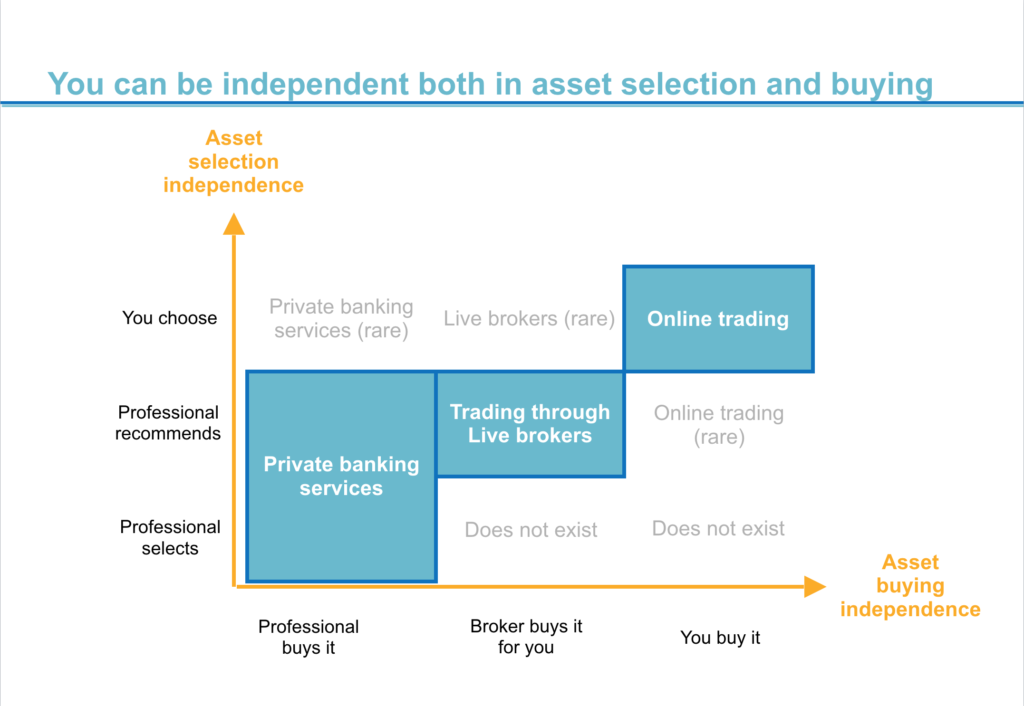
Both asset selection and asset trading can be done by you, with the help of a financial institution and by the financial institution. Here is a neat chart to help you understand.
Investing Your Money: Explainer Image on Asset Selection and Asset Buying
Investing Your Money: Explainer Image on Asset Selection and Asset Buying
In case you are a private banking customer, a professional helps you to decide in which assets to invest (asset selection) and even buys it for you if you do not want to bother.
Another option is the live broker. He can call you with ideas (recommendation), and during the phone conversation you can ask him to place an order (buying).
You are most independent when you trade through an online broker. You can select the assets you want to invest in. There are a lot of options to scan them, from basic free tools such as Yahoo’s or Google’s finance offerings, or you can have far more insights using paid services, such as Stockopedia. You do the research and selection on your own, than you buy the assets on the trading platform on your own again.
We tell more about the advantages of live brokers in the article about the different types of broker businesses. In short: they can help a lot, they are not cheap at all, and it is not easy to find a good one. More or less it is true for private banking services as well. We do not have good experience neither with private bankers nor with live brokers. But it is also true that we did not hold lengthy castings for them.
Products as investment helps
Saying that products can help you with your investments sounds very academic, but really what we are talking about here are funds. Investing in funds helps you not having to buy all the papers separately. You do not need to watch which asset performs how, when to sell them, etc. This has different levels as well, so let’s start with a more known one.
What we usually call investment funds are active funds. It is active because there is one guy who manages it actively. This means that funds collect your and other people’s money and invest it in stocks. From very simple funds (e.g. includes only government bonds) to complicated funds (e.g. fifth of the money can be invested only in Croatian real estate) you can find everything. The fund manager guy is bound to the fund’s declared investment strategy, so it is not entirely up to his theories what will happen to your money.
This sounds really nice, you have a professional who works all day for increasing your money.
But this also means that as an investor you have zero influence on what assets he should buy as long as he follows the investment strategy. Plus, active funds are very expensive.
After hearing about active funds you might guess that there are passive funds as well. And you are right. They are called ETFs. This means that the fund has a very strict investment strategy. In most cases this means a rule that it follows. For instance, it buys all the shares from the S&P 500 Index. Buying a fund equals buying all the shares.
There are lots of different ETFs. To name an example, it can buy automobile industry shares according to a determined proportion. This kind of ETF also helps you with your investments as the proportions were determined by a professional. The biggest advantage of these fund are their low prices.
Ok, so let’s summarize it. If you do not want to trade entirely on your own, then you can find a professional who can help you select an asset or buy it. If you do not want this, then the easiest solution is to put your money in an active fund where a professional manages it (it is expensive but professional) or in a passive fund.