Best brokers to buy ETFs online
[site-breadcrumb]
A Beginner-Friendly Guide to Buying ETFs Online
Exchange-traded funds (ETFs) have gained significant popularity since they were first introduced in 1993. Their appeal largely comes from their low costs and the fact that they can be traded easily, just like individual stocks.
In this guide, we break down—without complicated jargon—how to buy ETFs online and highlight what to look for when choosing a suitable broker. While the process may seem complex at first, it’s far from difficult once you understand the basics.
You’ll also discover the key differences between US and EU ETFs, helping you determine which option best fits your investment strategy.
But wait, what are ETFs?
If you don’t know, no worries. Either jump to the ETF 101 section or alternatively, check this shorter, catch-all summary.
Now, let’s take a look at the 6 steps to buying ETFs online.
How to buy ETFs online
6 steps of buying ETFs online
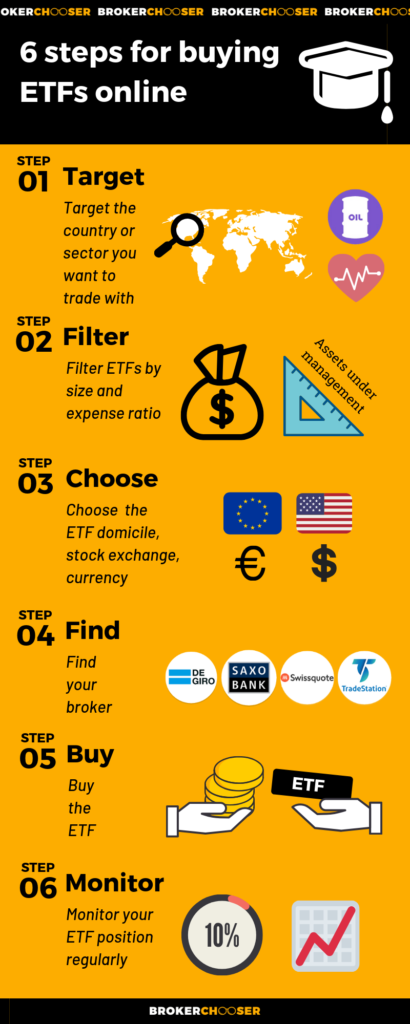
Buying ETFs online is not rocket science. Follow this 6-step plan:
- Target the country or sector you want to trade with
- Filter ETFs by size and expense ratio
- Choose the ETF domicile, stock exchange, currency
- Find your broker
- Buy the ETF
- Monitor your ETF position regularly
Step 1: Target the country, region, or sector you want to trade with
ETFs can be a tool for you to bet on how a country, region, or sector will perform. For example, if you think that the US market will go up, you can buy an ETF that tracks a stock index compiled of US stocks, such as the S&P 500 Index. If you think that not the whole US market but the technology sector will go up, you can buy an ETF that tracks a stock index containing US technology stocks, for example, the NASDAQ 100.
For targeting and filtering ETFs you will need an ETF screener. Use justETF for EU-domiciled ETFs and ETF.com for US ETFs.
Step 2: Filter for the ETFs by size and expense ratio
You will find several ETFs you can choose from, so some criteria can help in the filtering. The ETFs with bigger sizes are better as they are more liquid, which means more people trade with them. The ETF size is specified in AUM or assets under management. There is a rule of thumb you can follow: the ETFs with AUM higher than $100 million are usually more liquid.
The ETFs with lower expense ratios are better. The expense ratio shows what is the average annual fee of the ETF. The ETFs with lower than 0.1% expense ratios are very good.
Step 3: Choose the ETF domicile, stock exchange, and currency
The domicile means the country where the ETF was issued. The majority of the ETFs have EU or US domicile. Different domiciles most probably would mean different taxation for you. We are not here to give you tax advice, so always check this topic with your accountant. One more thing. After January of 2018, EU investors usually cannot buy US-domiciled ETFs due to the new PRIIPS regulation.
WHAT IS THE DIFFERENCE BETWEEN US AND EU ETFS?
The stock exchange listing does not equal to the domicile. An ETF can be traded on several stocks exchanges. Choose the stock exchange with the lowest commission. The commission depends on your broker.
The different stock exchange could mean different currency. Choose an ETF with the same currency as your brokerage to avoid currency conversion fees.
| Saxo Bank | Fusion Markets | CMC Markets | Interactive Brokers | Capital.com | |
|---|---|---|---|---|---|
| EURUSD spread | 0.8 | 0.0 | 0.7 | 0.1 | 0.6 |
| GBPUSD spread | 1.3 | 0.2 | 0.9 | 0.3 | 1.3 |
| AUDUSD spread | 0.8 | 0.0 | 0.7 | 0.1 | 0.6 |
| EURCHF spread | 1.4 | 0.6 | 2.5 | 0.4 | 2.2 |
| EURGBP spread | 1.4 | 0.3 | 1.1 | 0.2 | 1.5 |
Let’s take as an example the Japanese ETF of BlackRock. BlackRock issued its ETFs covering the main Japanese stock market in both Europe and the US. In both continents, you can trade this ETF on several exchanges and in different currencies.
Step 4: Find your broker
Once you’ve chosen the ETF you want to invest in, the next step is selecting a reliable online broker. You can use comparison tools to get personalized suggestions based on a few simple questions, or continue researching to find a well-suited broker that meets your overall investing needs.
At broker recommendations, we take into account the broker’s fees, trading platform, accessible markets to trade, and how easy it is to open an account. Safety is also highly important, but since we recommend only safe brokers, you do not have to worry much here.
After you opened your account you will need to deposit money into it.
Step 5: Buy the ETF
You have the target, the account, and the cash. The last step is to push the buy button. You log in to your online trading platform, search for the ETFs you wish to buy and click buy. When placing an order, you can choose from different order types.
After you opened your account you will need to deposit money into it.
Step 6: Monitor your ETF positions regularly
You are done, your ETFs are bought. Now it is key to monitor your investments. If you bought the ETF for holding it for a longer-term, you might check it on a monthly or yearly base.
For short time buyers, the position management could mean setting up the stop-loss price of where to cut the losses and the target price of where you want to sell the ETF with a profit.
Now that you have mastered the 6 steps of buying ETFs, take a moment to look at the top four brokers we have selected for you.
How to buy ETFs online
Best brokers to buy ETFs online
If you just start to explore how to buy ETFs online, we recommend you to choose between the following four brokers. We tested all of them, and we have live accounts with them.
| Saxo Bank | Fusion Markets | CMC Markets | Interactive Brokers | Capital.com | |
|---|---|---|---|---|---|
| EURUSD spread | 0.8 | 0.0 | 0.7 | 0.1 | 0.6 |
| GBPUSD spread | 1.3 | 0.2 | 0.9 | 0.3 | 1.3 |
| AUDUSD spread | 0.8 | 0.0 | 0.7 | 0.1 | 0.6 |
| EURCHF spread | 1.4 | 0.6 | 2.5 | 0.4 | 2.2 |
| EURGBP spread | 1.4 | 0.3 | 1.1 | 0.2 | 1.5 |
If you are interested in more details of these brokers, visit this article.
How to buy ETFs online
What is an ETF?
An ETF is fund traded on a stock exchange. A fund can include any assets types, like equities, bonds, commodities, and even forex. One fund usually has more assets. For example, a fund that is following the S&P 500 Index holds 500 equities. The most popular ETFs are equity ETFs that follow popular equity indexes, like NASDAQ 100 and S&P 500.
An ETF is issued by an asset management company like Vanguard or BlackRock. One asset management company can issue many ETFs.
Why are ETFs so popular? In a few words: low cost, easy access, endless choices, and liquidity.
ETF – low cost
Investing in ETFs is usually much cost-efficient than investing in mutual funds. The overall annual cost of an ETF can be below 0.1% while mutual funds often charge 1-2% management fee per year. Why ETF is cheaper? Because ETFs are usually passive investments. ETFs just automatically replicate the indexes or other asset baskets, and there is not a fund manager who continuously rebalance the fund’s portfolio in the hope of higher returns.
An ETF is issued by an asset management company like Vanguard or BlackRock. One asset management company can issue many ETFs.
Why are ETFs so popular? In a few words: low cost, easy access, endless choices, and liquidity.
ETF – easy access
ETFs are traded on exchanges. Therefore, you can buy them straight away. Contrary, the buying process of a mutual fund is more complicated and you can transact only once a day at a fixed price. The low minimum investment amounts can also help you to easily access ETFs. At mutual funds, the minimum investment amounts can be as high as $3,000
An ETF is issued by an asset management company like Vanguard or BlackRock. One asset management company can issue many ETFs.
Why are ETFs so popular? In a few words: low cost, easy access, endless choices, and liquidity.
ETF – endless choices
ou can choose from many regions, sectors, or anything you are interested in. You anticipate the Chinese economy will fly? You can invest an ETF which tracks Chinese indexes. You like the healthcare and want to invest in that? Choose an ETF which tracks healthcare companies. You can already invest in crypto ETFs as well.
An ETF is issued by an asset management company like Vanguard or BlackRock. One asset management company can issue many ETFs.
Why are ETFs so popular? In a few words: low cost, easy access, endless choices, and liquidity.
ETF – liquidity
The ETFs are more liquid than mutual funds. You can trade with the ETFs throughout the day and the prices change continuously.
An ETF is issued by an asset management company like Vanguard or BlackRock. One asset management company can issue many ETFs.
Why are ETFs so popular? In a few words: low cost, easy access, endless choices, and liquidity.
How to buy ETFs online
US or EU ETFs?
Once you understand the fundamentals of buying ETFs online and have identified suitable brokers, it’s worth taking a closer look at the structure of the US and EU ETF markets.
These two regions dominate the global ETF space, with the United States representing roughly 70% of the market, while Europe accounts for about 20%.
When referring to US or EU ETFs, the key concept is domicile—the country or region where the ETF is legally registered. For example, an ETF tracking the S&P 500 Index can exist in both US-domiciled and EU-domiciled versions. Although they follow the same underlying index, their legal structure and regulatory framework differ.
If you’re deciding between US and EU ETFs, three important factors should guide your choice: tax treatment, liquidity, and regulatory environment.
ETFs are created and managed by asset management firms such as Vanguard or BlackRock, with each provider offering a wide range of funds covering different markets and strategies.
So why have ETFs become so widely used? Simply put, they offer low costs, straightforward access, broad selection, and strong liquidity, making them an attractive option for both beginners and experienced investors.
Taxation
The taxation of ETFs depends on
- the domicile of the ETF and
- your tax residency.
You may face withholding tax, income tax, and capital gain tax when you trade with ETFs. Always ask your accountant or your tax advisor on this topic.
Liquidity
As of 2018 December, the EU ETF market has a value of $800 bn. You surely think that this is huge. Yes, it is but lags behind US’s $3,700 bn. The differences in the size have a huge impact on the liquidity, i.e. how easily you can buy or sell the ETF. The more liquid the ETF, the more likely to buy or sell the ETF in a very short time and at a very low spread cost. The EU ETFs are less liquid than the US ETFs. Therefore you will likely have higher spreads at EU ETFs which means a higher cost.
Regulation
From January 2018, the European clients are usually blocked from trading many US-domiciled ETF. That’s because US ETFs lack the KID or Key Information Document. The is KID is required by the PRIIPS (Packaged retail investment and insurance-based products), a European regulation came into force at the beginning of 2018. The biggest ETF issuers said that they would not intend to provide the KIDs for US-domiciled ETFs. Instead, EU clients could trade with similar EU-domiciled ETFs which comply with the new PRIIPS regulation.
How can you know that an ETF is fully compatible with the EU regulation? Just look at the ETF’s name: those having the “UCITS” adjective are surely compatible with the EU regulation and are EU-domiciled.
So, you cannot trade with US-domicile ETFs at all? Yes, you can, but is quite complicated. Some brokers may allow you to qualify as a professional client. In this case, you will need a large portfolio, over €500,000, trading experience, and some professional background.
How to buy ETFs online
Bottom line
How to buy ETFs online? How can I buy ETFs? I want to invest in ETFs online! I want to buy ETFs! Were these things you were saying until now?
Just follow these six easy steps to buy ETFs online:
- Target the country, region, or sector you want to trade with
- Filter ETFs by size and expense ratio
- Choose the domicile, the stock exchange and the currency of the ETF
- Find your broker
- Buy the ETF
- Monitor your ETF positions regularly
If you are still in doubt which broker to choose, we compiled a brief summary to help:
| Saxo Bank | Fusion Markets | CMC Markets | Interactive Brokers | Capital.com | |
|---|---|---|---|---|---|
| EURUSD spread | 0.8 | 0.0 | 0.7 | 0.1 | 0.6 |
| GBPUSD spread | 1.3 | 0.2 | 0.9 | 0.3 | 1.3 |
| AUDUSD spread | 0.8 | 0.0 | 0.7 | 0.1 | 0.6 |
| EURCHF spread | 1.4 | 0.6 | 2.5 | 0.4 | 2.2 |
| EURGBP spread | 1.4 | 0.3 | 1.1 | 0.2 | 1.5 |