WallStreetBets and a silver short squeeze
[site-breadcrumb]

Many investors consider adding silver to their portfolio as a way to broaden diversification with exposure to precious metals. A common first question is simple: what’s the best way to buy silver? With multiple investment routes available, choosing the right one can feel overwhelming at the beginning.
This guide explores the different ways you can gain exposure to silver — from silver ETFs to other financial instruments — whether your goal is long-term investing or shorter-term trading. Silver ranks among the world’s most actively traded commodities and has a fascinating historical background that continues to shape its appeal today. While investing in silver, including through ETFs, can appear complex at first, the following sections aim to help you determine the most suitable instrument and trading platform for your needs.
The good news is that modern technology has made silver investing far more accessible. Today, you can buy and trade silver entirely online with ease.
This article is designed to support your silver investment journey by covering:
-
The various methods of trading silver, including ETFs
-
The historical evolution of the silver market, including its most famous speculative episode
-
The role of WallStreetBets and the discussion around a potential silver short squeeze
Ultimately, deciding whether silver should be your first commodity investment depends on your personal objectives and risk tolerance. It is always wise to consult a qualified financial advisor before making investment decisions, as this content is provided strictly for informational purposes and does not constitute investment advice.
How to Buy Silver
Silver ETF and other forms of silver trading
Great — once you’ve clarified your objectives and decided that silver fits your strategy, the next step is understanding how to actually gain exposure.
Before you can officially say you “own” silver, there are two key decisions to make:
-
Choose the form of silver you want to invest or trade.
-
Select a broker that offers that product under conditions that align with your needs (fees, platform quality, regulation, etc.).
Below, we’ll break down the main product categories, along with their advantages, drawbacks, and typical cost structures:
-
Silver ETFs
-
Silver CFDs
-
Silver options
-
Silver futures
-
Silver spot forex
Silver ETFs
What Is a Silver ETF?
A silver ETF (Exchange-Traded Fund) is a fund that provides exposure to silver-related assets. An ETF is essentially a basket of securities — such as stocks, bonds, or commodities — designed to track a specific index or asset.
Unlike traditional mutual funds, ETFs trade on stock exchanges throughout the day, just like regular shares. This makes them highly accessible and liquid.
For investors who want exposure to silver without dealing with physical storage, ETFs offer a convenient solution.
Silver ETFs typically fall into two categories:
-
Physically backed ETFs that track the price of silver bullion
-
Equity-based ETFs that invest in silver mining companies
Technically, products that track physical commodities are often structured as exchange-traded commodities (ETCs), though many investors use the term ETF broadly.
If you want to explore ETF investing more deeply, reviewing a detailed guide on how to buy ETFs online can be helpful before taking action.
Important Features of Silver ETFs
Here are the key characteristics you should understand before investing:
1. Easy Access
You can buy and sell silver ETFs through most standard brokerage accounts, just like stocks.
2. Liquidity
Major silver ETFs trade with high volume, making entry and exit relatively simple.
3. No Physical Storage Required
You gain price exposure without worrying about vaulting, insurance, or transportation.
4. Management Fees
Silver ETFs charge an annual expense ratio. While typically modest, this fee slightly reduces long-term returns.
5. Market Risk
Silver ETFs are fully exposed to price volatility. If silver drops, the ETF declines accordingly.
6. Counterparty & Structure Risk
Some ETFs hold physical silver, while others use derivatives or invest in mining stocks. Understanding the structure is important before investing.
Silver ETFs are often considered the most beginner-friendly way to invest in silver because they combine accessibility, liquidity, and simplicity.
In the next sections, we can explore more advanced instruments like CFDs, futures, and options — which offer leverage but also come with higher risk.
| Can you use leverage or go short? | No, unless you use a margin account |
|---|---|
| What type of costs can occur? | Commission Custody fee Spread Fees charged by ETF issuers (e.g. expense ratio) |
| Ticker(s) of silver ETFs* | SLV, SIVR, SIL. AGQ |
| Further things to consider | Liquidity is usually high Wide range of silver ETFs available |
*These are some of the largest silver ETFs based on assets under management
Best brokers to buy silver ETFs
We selected the best brokers to buy silver ETFs based on whether the broker provides access to a silver ETF and it has favorable ETF fees:
- for US customers:
- TD Ameritrade
- E*TRADE
- Charles Schwab
- Merrill Edge
- Ally Invest
- for non-US customers:
- DEGIRO
- Interactive Brokers
- eToro
- TradeStation
- Firstrade
Silver CFDs
What is a silver CFD?
A silver CFD is a financial contract that pays the difference in the settlement price between the open and closing trades (CFD is short for ‘contract for difference’). It is popular for forex and commodities products. For silver CFDs, the underlying asset can be either a silver ETF or silver forex (the above-mentioned silver categories). When you buy silver CFDs, you bet on the price change of the underlying asset. This means that:
- You don’t own the underlying silver ETF. The price of a silver ETF CFD follows the price of silver ETFs listed on exchanges.
- There is no delivery as in the case of a spot forex market. The price of a silver CFD follows the price of silver forex on the spot market.
According to ESMA regulation, the leverage on ETF CFDs is 1:5, while on XAGUSD CFDs it is 1:10. Always use a stop-loss order to manage your risk. It is important to note that even so, you may lose more during gaps (sharp breaks in the price with no trading occurring in between). In this case, the price can jump over your stop-loss level, causing higher losses than you had set up to allow. Please be aware that trading on margin and other leveraged trading strategies could be extremely risky in times of high market volatility. Sharp price moves could quickly wipe out your invested capital.
If you would like to learn more about CFDs, read our article on CFD trading.
Important features of silver CFDs
| Can you use leverage or go short? | Yes |
|---|---|
| What type of costs can occur? | Spread Commission Swap (cost for holding a position overnight) |
| Ticker(s) of silver CFDs | Ticker of the underlying asset, e.g. XAGUSD, SLV |
| Further things to consider | Silver spot forex CFD market is open 24 hours a day, except on weekends |
Best brokers to buy silver CFDs
We selected the best brokers to buy silver CFDs based on whether the broker provides a silver CFD and it has favorable CFD fees:
- for US customers: – (CFDs are not available for US residents)
- for non-US customers:
- ActivTrades
- HYCM
- AvaTrade
- XM
- eToro
Silver options
What are silver options?
A silver option is a financial instrument that is a derivative based on the value of silver. Silver options are traded through the Chicago Mercantile Exchange (CME), trading under the symbol SO. An options contract offers the buyer the opportunity to buy or sell—depending on the type of contract they hold—the underlying asset.
A call option on silver means a financial contract that gives the owner the right, but not the obligation, to buy silver at a specified price within a specific time period.
A put option on silver means a financial contract that gives the owner the right, but not the obligation, to sell silver at a specified price within a specific time period.
If you would like to learn more about futures options trading, read our article on futures options trading.
Important features of a silver option
| Can you use leverage or profit form price decreases? | Yes, with a put option |
|---|---|
| What type of costs can occur? | Spread Commission Carry cost (cost for holding a position overnight) |
| Ticker(s) of silver option | Ticker of the underlying asset, e.g. XAGUSD, SLV |
| Further things to consider | Great risk management tool if appropriately used |
Best brokers to buy silver options
We selected the best brokers to buy silver options based on whether the broker provides silver options and it has favorable options fees:
- for US customers:
- TD Ameritrade
- E*TRADE
- Charles Schwab
- Interactive Brokers
- Zacks Trade
- for non-US customers:
- Interactive Brokers
- Zacks Trade
- TradeStation
- tastyworks
- TradeStation Global
Silver futures
What are silver futures?
Silver futures are derivative financial contracts that obligate the parties to transact an asset at a predetermined future date and price. Similar to silver forex, silver CFDs and silver options, silver futures are leveraged and complex products. The buyer must purchase or the seller must sell the underlying asset at the pre-set price, regardless of the current market price at the expiration date.
Underlying assets include physical commodities or other financial instruments. Silver is one of the commodities you can trade as a future. In the US, silver futures are primarily traded on COMEX (Commodity Exchange).
If you would like to learn more about this type of trading, read our article on futures options trading.
Important features of silver futures
| Can you use leverage or go short? | Yes |
|---|---|
| What type of costs can occur? | Spread Commission Carry cost (cost for holding a position overnight) |
| Ticker(s) of silver futures | SI (+month and year) |
| Further things to consider | Liquidity is high High margin requirement |
Best brokers to buy silver futures
We selected the best brokers to buy silver futures based on whether the broker provides silver futures and it has favorable futures fees:
- for US customers:
- TradeStation
- Interactive Brokers
- NinjaTrader
- tastyworks
- Charles Schwab
- for non-US customers:
- DEGIRO
- TradeStation
- Interactive Brokers
- TradeStation Global
- NinjaTrader
Silver spot forex
What is a silver spot forex?
A silver spot forex is a spot commodity based on the price of silver and traded against the US dollar. It shows how much silver is worth against USD.
According to ESMA regulation, the leverage on XAGUSD is 1:10. Please be aware that trading on margin and other leveraged trading strategies could be extremely risky in times of high market volatility. Sharp price moves can quickly wipe out your invested capital.
Taking gaps and volatility into consideration, similar risks are associated with spot forex products as with CFDs. On the forex market, gaps primarily occur over the weekend because it is the only time the market is closed. If you want to learn more, read our article on forex trading.
Important features of silver spot forex
| Can you use leverage or go short? | Yes |
|---|---|
| What type of costs can occur? | Spread Commission Carry cost (cost for holding a position overnight) |
| Ticker(s) of silver spot forex | XAGUSD |
| Further things to consider | Liquidity is high Forex market is open 24 hours a day, except on weekends |
Best brokers to buy silver spot forex
We selected the best brokers to buy silver spot forex based on whether the broker provides silver spot forex and it has favorable forex fees:
- for US customers:
- Forex.com
- Interactive Brokers
- TD Ameritrade
- Oanda
- for non-US customers:
- Forex.com
- Saxo Bank
- Questrade
- Interactive Brokers
- Swissquote
Taxation of silver trading
Silver differs from gold in that while in the European Union the trading of recognized gold coins and bulllion products is VAT exempt, there is no such allowance for silver trading.
How to Buy Silver
History and the biggest speculation in silver trading

As a precious and industrial metal, silver can also be used as an investment. It has been regarded as a form of money and store of value for more than 4,000 years. In 2020, global silver reserves amounted to 560,000 tonnes.
The price, as with commodities, is driven by speculation, supply and demand. The price of silver is notoriously volatile compared to gold because of its smaller market and lower liquidity.
Silver often tracks the price of gold, although the ratio can vary. The gold/silver price ratio was fixed by law in the United States with the Coinage Act at 15:1 in 1972, which meant that one troy ounce (ca. 31 grams) of gold was worth 15 troy ounces of silver.
The market of silver is much smaller in value than the gold market. The London gold bullion market turns over 18 times more monetary value. Due to its smaller size, a single large investor may be able to influence the price of silver in either direction.
Around 60% of silver is used in industry and 40% for jewelry, silverware and silver bullion.
Source: Katusa research
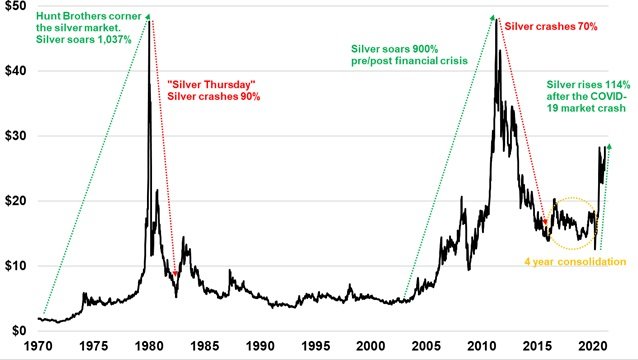
As seen on the chart above, the price of silver fell sharply during the COVID-19 market crash in the spring of 2020, but it recovered quickly, rising 114% after the crash. The overall increase of silver was around 48% for 2020. In comparison, the S&P 500 Index rose 16% in the same year. In the first month of 2021, the price of silver went up 2.2%, while the S&P decreased by 1.1%.
The chart below shows the performance of other metals compared to silver. A strong correlation can be seen between silver and gold. Both instruments traditionally perform well in times of rising inflation.
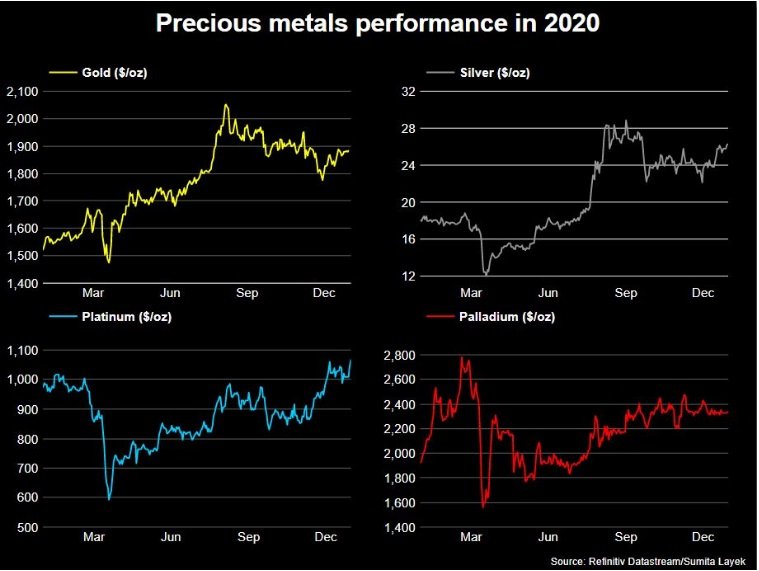
Historical data shows that silver can surge at breathtaking speed during bull runs — but it can also unravel just as violently. Over the past 50 years, the market has experienced two major crashes. The most dramatic episode remains the attempted market domination by the Hunt brothers in 1980.
Silver and the Hunt Brothers
More than four decades ago, one of the largest speculative events in commodity market history unfolded. The Hunt brothers succeeded in driving silver prices up more than sevenfold before the market ultimately collapsed.
The story began in 1974, when oil tycoon H.L. Hunt passed away, leaving his sons Herbert and Nelson with a vast inheritance. Believing that inflation would significantly boost precious metals, they focused their attention on silver.
Using their substantial fortune, they aggressively accumulated both physical silver and silver futures contracts. Importantly, instead of settling futures in cash, they demanded physical delivery. This strategy intensified supply pressure and pushed silver prices from around $7 per ounce to nearly $50 by 1979.
However, even their initial wealth — estimated at roughly $1 billion — was not enough to fully control the market. To expand their influence, they borrowed heavily and encouraged other affluent investors, including wealthy Saudi backers, to join them in purchasing silver as an inflation hedge. As participation grew, U.S. regulators began scrutinizing their activities more closely.
At one point, the brothers effectively controlled close to two-thirds of the available silver supply.
Traders holding short positions soon found themselves in trouble. With limited silver available for delivery, panic set in — creating a classic short squeeze. At the peak of the frenzy, the Hunts’ combined wealth swelled to approximately $4.5 billion.
Concerned about market manipulation and the stability of national reserves, authorities stepped in. The Commodity Exchange Inc. (COMEX) introduced “Silver Rule 7,” imposing strict limits on margin-based purchases. As margin requirements increased sharply, silver plunged more than 50% in just four days.
Although the brothers initially secured additional credit, the Federal Reserve moved to curb speculative lending. The crisis climaxed on March 27, 1980 — a day later known as Silver Thursday — when the Hunts failed to meet margin requirements on a major loan. Forced to liquidate massive positions, they triggered a collapse that sent silver tumbling from $48.70 to roughly $11 per ounce.
The aftermath caused significant disruption across financial markets. While a consortium of private banks temporarily stabilized the situation, it took nearly a decade for the brothers to unwind their holdings and settle debts. In 1988, they were found liable in civil court for conspiring to corner the silver market, leading to bankruptcy in one of the largest filings in Texas history.
The Hunt brothers’ saga remains a powerful reminder of how leverage, speculation, and regulatory intervention can reshape commodity markets in dramatic fashion.
How to Buy Silver
WallStreetBets and a silver short squeeze
In the final weeks of January 2021, financial markets experienced extraordinary turbulence. A large online community on Reddit known as WallStreetBets began purchasing inexpensive, out-of-the-money call options on heavily shorted stocks. This coordinated activity generated dramatic price surges in names such as GameStop and AMC Entertainment.
As attention concentrated on these stocks, a powerful short squeeze unfolded, forcing short sellers to buy back shares to cover their positions, which propelled prices even higher.
How the Mechanism Worked
When traders buy call options anticipating a price increase, market makers typically sell those options and hedge their exposure by purchasing the underlying shares — a process known as delta hedging. As call buying intensifies, market makers must acquire more shares to remain hedged. This added demand can push stock prices up further, increasing the options’ delta and requiring even more hedging purchases — creating a self-reinforcing upward cycle.
The opposite effect can occur with put options. When traders buy puts expecting prices to fall, market makers sell those contracts and hedge by selling shares. As prices decline, out-of-the-money puts gain delta, requiring additional selling to maintain hedges. This feedback loop can accelerate downward pressure, a dynamic often described in options markets as a gamma-driven spiral.
The Attempted Silver Squeeze
Toward the end of January, WallStreetBets participants shifted their focus to silver, hoping to replicate the dramatic squeeze seen in GameStop — this time in the physical metal and related financial instruments.
To trigger a similar move, retail investors would have needed to:
-
Buy shares of the iShares Silver Trust (SLV)
-
Accumulate other silver-focused ETFs
-
Influence activity in the silver futures market
-
Force option market makers to continue purchasing SLV shares to maintain delta hedges
Interest Surging
Following this shift in attention, activity in silver-linked derivatives increased sharply. Options volume and call skew in the silver market climbed to levels not seen since the summer of 2020, reflecting heightened speculative interest.
In the next section, we’ll examine what actually happened in the silver market — and whether a retail-driven short squeeze in silver was realistically achievable.
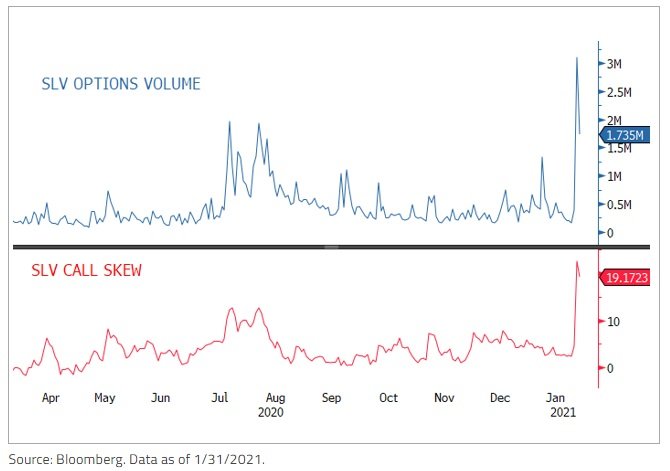
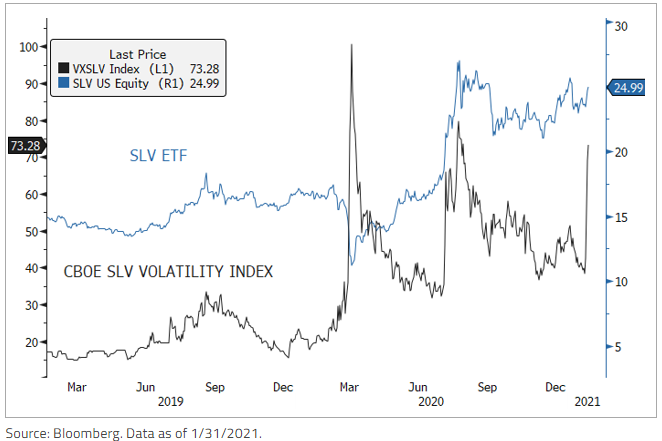
Another data from Bloomberg is volatility, which increased extremely:
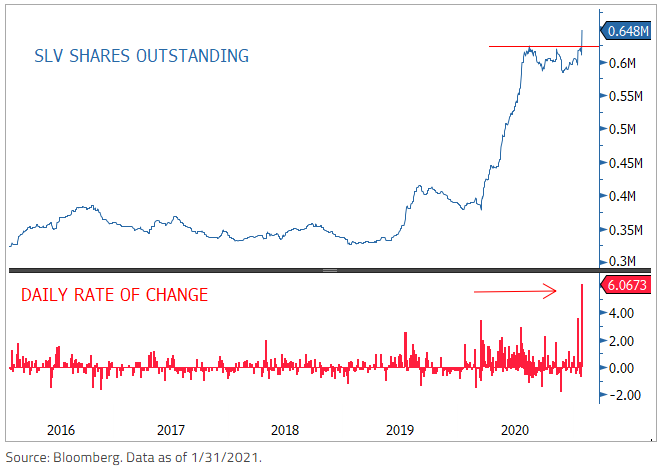
This graph shows the daily inflow of silver shares, which was the largest in five years:
Another interesting development in silver was that its futures were in backwardation in February 2021, which is very rare in this market. This is a market condition where the price of a commodity’s forward or futures contract is trading below the expected spot price at contract maturity. This previously happened in:
- March 2020
- September 2015
- February 2011
After these periods of backwardation silver rose significantly.
All these figures indicate that interest in silver has grown significantly. Where is this money inflow coming from?
According to the latest Commitment of Traders report, a weekly publication that shows the aggregate holdings of different participants in the US futures market, over 80% of long positions were held by hedge funds, swap dealers, industrial users and producers.
High barrier to entry
In the case of commodity futures, the barrier to entry is much higher for retail traders like WallStreetBets:
- High initial and maintenance margins: $15,000 for standard silver futures, for physical delivery of 5,000 oz.
- Complexity of instruments and their high degree of leverage to the underlying commodity.
- Market access is more complicated: it cannot be traded on discount broker platforms like Robinhood, for example.
This means that you cannot simply open an account with a $1000 balance and start trading silver in the futures market. At least $100,000 is needed to trade exclusively in futures.
According to the Commodity Futures Trading Commission, the value of all open silver futures contracts on the Chicago Mercantile Exchange at the end of January 2021 was $21.4 billion, with 44% coming from hedge funds. This market is too big for retail investors like WallStreetBets to create the same kind of volatility as they did with GME.
On a global comparison, the market cap of silver is small. You can see the differences compared to other industries in the chart below (data based on early February 2021):
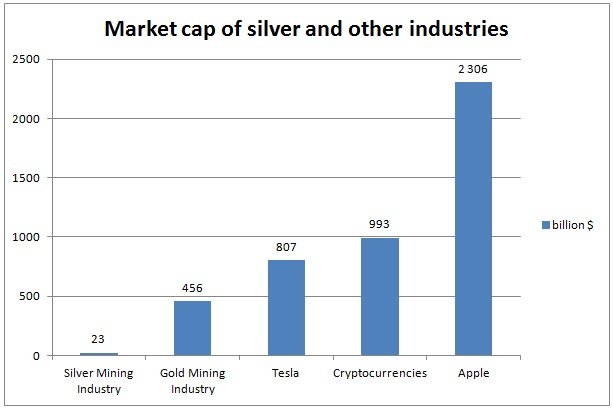
There are also huge differences between precious metals, as the gold mining industry for example is 20 times larger than that of silver mining. And even both of these combined are smaller than Tesla.
Target: mining firms?
So is there anything related to the silver industry that these Reddit players can possibly short squeeze at all?
One possibility is if they target silver mining companies with secondary listings on the NYSE or the NASDAQ. These stocks have seen their volatility increase in recent weeks, but compared to the stocks whose trading was restricted at Robinhood, the trading volume in silver mining stocks is very low.
The mining companies in question are:
- Pan American Silver (PAAS)
- Hecla Mining (HL)
- Mag Silver (MAG)
- Fortuna Silver (FSM)
- First Majestic Silver
Other than First Majestic Silver, institutional short positions in these stocks are below 5%. In comparison, it was more than 100% at GameStop prior to the short squeeze. That is a huge difference.
Thus, the lack of short interest means no silver short squeeze for WallStreetBets.
How to Buy Silver
Bottom line
As a precious and industrial metal, silver can also be used as an investment. It is one of the top 10 commodities, and there are several different forms for silver trading or investing:
- Silver ETFs
- Silver CFDs
- Silver options
- Silver futures
- Silver spot forex
A strong correlation can be seen between silver and gold. Both instruments traditionally perform well during times when inflation rises. Silver differs from gold in terms of taxation.
Interest towards silver has grown: the daily inflow of capital into silver shares is the largest in five years. Silver options reached new highs compared to the summer of 2020.
Silver futures were in backwardation in February 2021, which is very rare in this market. After the last three periods of backwardation silver rose significantly.
According to industry reports, over 80% of long positions are held by hedge funds, swap dealers, industrial users and producers.
Currently, there is a lack of short interest on the silver market, which means no silver short squeeze for WallStreetBets.
Therefore, the biggest speculation in silver history remains the one carried out by the Hunt Brothers.